When I was studying at elementary I had learn that Philippines has its own national symbols. At that time I never had any interest about it. When I grow up and I live in my own I realized how important those symbols to my life because it represents to me being "Pinoy". By then, I started collecting some old coins and bills as well trying to visit some places where I can see those national symbols like: the monkey eating eagle I saw it in Davao City and the tarzier I saw it in Bohol. My adventure experience helps me learn more about the national symbols of the Philippines and how important to us Filipino and this is what I discover:
 |
Jose Rizal (National Hero)
|
Jose Rizal is the Philippines national hero
and pride of the Malayan race, was born on June 19, 1861, in the town of Calamba, Laguna. He was the seventh child in a family of 11 children (2 boys and 9 girls). Both his parents were educated and belonged to distinguished families. He was considered hero because he was the first filipino who fight against the Spaniards and wrote a book against the Spanish people NOLI ME TANGERE, EL FILIBUSTERISMO and a poem Ultimo Adios. He died at Bagumbayan Field in the cold morning of December 30, 1896 a man whose 35 years of life had been packed with varied activities which proved that the Filipino has capacity to equal if not excel even those who treat him as a slave.
 |
| Sampaguita flower |
Sampaguita flowers are very popular in the Philippines where they are strung into necklaces and sold in the streets of Manila. They are usually given to tourists, new graduates, and competition winners either as traditional welcome offerings or as honorary symbols for their achievements. The garlands are also given to saints, whether in churches or altars at home. The flowers are treasured for their distinct fragrance, and are even used in perfumery and tea-making.
The name “sampaguita” is believed to have come from the Filipino words “sumpa kita,” meaning “I promise you.” In early days sampaguita garlands are exchanged by young couples as a pledge of their love, not unlike the exchange of rings in wedding ceremonies.
 |
| Bangus |
Milkfish, Chanos chanos (Forsskal), locally known as "bangus" or "bangos", is the predominant species being cultured in the Philippines. Hundreds of years ago bangus was grown in ponds along coastal areas. That was the beginning of fish fanning. Bangus is a popular table fare among Filipinos. To the biologist, it is an innately sturdy fish, being able to adapt and thrive even in the confined, unnatural environment of the fishpond. This characteristic is not often found in most other fish species.
 |
| Nara Tree |
National Tree: Narra (Pterocarpus indicus) is a beautiful and strong tree. It is a favorite wood for furniture but because there are only a few trees left, cutting down a Narra tree is no longer allowed.It is found in Bicol, Mindanaoand the Cagayan Valley forests and in Juana Osmena Blvd. St., Cebu City
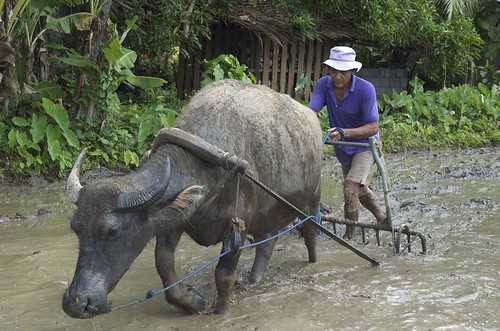 |
| Carabao |
The carabao is also considered a national symbol of the Philippines as well as in Guam. They were imported into Guam from the Philippines in the late 1600s during the Spanish colonial administration of Guam as a beast of burden and as transportation. They were used for farming and to pull "carabao carts." As recently as the early 1960s, carabao races were a popular sport on Guam, especially during fiestas.

The monkey-eating eagle, the Philippine eagle is unique to the forests of the Philippines. Deforestation through logging has been its primary threat, and now it is considered one of the most critically endangered species in the world, according to the International Union for the Conservation of Nature.
The tarzier the world smallest monkey in the world and can be found in Bohol Island Philippines also they are now of the most critically endangered species in the world. The monkey are very sentive and they must be touch or even taken a camera because they died.
♥ ♥ ♥ Eve`s journal ♥ ♥ ♥


